
Tax Reform for Growth in Canada
Report in Brief
This Report in Brief summarizes tax policy recommendations from CPA Ontario to drive economic growth in Canada. For the detailed analysis, supporting evidence, and references

Introduction
Canada's economic performance has virtually stalled over the past decade. Business investment per worker has fallen to half of U.S. levels, productivity has stagnated, and real GDP per capita has barely improved. At the heart of this challenge lies a tax system that has evolved into a barrier to the economic growth Canada so desperately needs.
Canada has ignored tax reform for too long, largely adopting a piecemeal approach to taxation rather than a comprehensive overhaul since the Royal Commission on Taxation in 1962. The result is a patchwork system ill-equipped for today’s economic challenges.
As trusted advisors across every sector of Ontario’s economy, Chartered Professional Accountants (CPAs) experience daily how tax complexity diverts resources from productive activities and how high tax rates discourage investment and entrepreneurship. CPA Ontario, with over 105,000 members, all with foundational training in tax and many with professional experience as tax practitioners, can offer important insight into how tax policy impacts economic growth.
A recent survey of CPA Ontario members revealed that 88% of members emphasized the importance of reforming the personal and corporate income tax system, with 84% describing it as overly complex. In response, CPA Ontario launched the Trade & Growth Insights program in February 2025 to provide growth-focused public policy advocacy.
CPA Ontario members’ views on Canada’s tax system
CPA Ontario’s member survey revealed deep concerns about Canada’s tax competitiveness:
- 88% believe reforming personal and corporate income tax is important.
- 84% say Canada’s income tax system overall is too complex.
- Two-thirds believe the tax system is inhibiting economic growth.
- 82% agree the federal tax system is overly complicated.
- 72% believe federal marginal income tax rates are too high.
- 63% say Ontario’s marginal income tax rates are too high.
The current moment demands more than incremental adjustments. With new competitive pressures from the U.S. on tax and trade, and Canada’s productivity challenges deepening, Canada needs a bold, comprehensive rethink of the Income Tax Act to modernize it for simplicity, equity, efficiency, and competitiveness, ensuring tax policy facilitates economic growth. This report presents 20 recommendations to reposition Canada’s tax system, developed through extensive research, tax expert engagement, and CPA Ontario member insights. Tax reform is a key lever, although not a silver bullet, for improving Canada’s economic performance. The time for meaningful tax reform is now.
Spur Innovation Through Tax Policy
As economies shift to knowledge-based industries, investments in innovation and intangible assets are increasingly key. But Canada's investment in business research and development (R&D) and information and communications technology (ICT) is middling, as are its patent applications by population. Canadian firms also struggle to commercialize their intellectual property (IP). Tax policy must be modernized to stimulate both upstream R&D and downstream commercialization.
“The SR&ED system has evolved to be generous for smaller firms, but there may be opportunities to rebalance that to make it neutral or at least a bit more balanced across firm sizes.”
– Brian Ernewein Senior Advisor, National Tax Centre, KPMG
CPA Ontario recommends:
- Reform the Scientific Research and Experimental Development (SR&ED) Tax Credit: The federal government should simplify the application for both the basic and enhanced investment tax credits to make it easier for qualifying businesses to access and navigate the program. It should also conduct a full review of existing expenditure qualification rules to ensure they reflect the reality of R&D for firms. The enhanced refundable tax credit expenditure limit should be increased significantly to reflect inflationary increases and the rising cost and importance of innovation. The eligibility of the enhanced refundable tax credit should be expanded to public and larger firms, with an increased taxable capital phase-out threshold. This approach would better reflect the scale of innovation spillovers these firms generate. In designing expanded eligibility, consideration should be given to prioritizing Canadian firms (i.e. those listed on domestic exchanges and not controlled by non-residents.)
“Current SR&ED thresholds don't match today's competitive reality - we need to raise them significantly.”
– John Ruffolo, FCPA, FCA, Founder and Managing Partner, Maverix Private Equity
- Introduce a Patent Box System to Incentivize Commercialization: Canada should move forward on commitments to create a domestic patent box regime, offering a preferential corporate tax rate on income derived from IP developed in Canada. This would encourage firms to retain IP and associated revenue within Canada, tied to domestic R&D activities.
"Right now, we're losing valuable IP to other jurisdictions. A patent box could bring some of that back to Canada, so we at least get some tax revenue from it instead of watching it all flow offshore."
– John Ruffolo, FCPA, FCA, Founder and Managing Partner, Maverix Private Equity
Reform Capital Gains Taxes
Canada’s approach to capital gains taxation has been a subject of considerable debate. High capital gains taxes discourage long-term investment and entrepreneurial activity, particularly in sectors reliant on venture capital and private equity. Taxes on capital are among the most economically damaging ways for governments to raise revenue, as they tend to lock in capital instead of moving it to more productive investments. Reforming capital gains taxation is key to stimulating business investment, innovation, and entrepreneurship, and any changes should be permanent to provide needed stability.
“If you are looking to incentivize long-term investing in the Canadian economy you can’t keep creating temporary windows. Short-term measures just encourage people to make quick trades to capture the benefit, rather than building lasting investment in the economy.”
– John McKenzie, FCPA, FCMA, CEO, TMX Group
CPA Ontario recommends:
- Maintain Commitment to Not Raising the Inclusion Rate and Consider Reducing It: While reversing the planned increase in the inclusion rate was an important first step, the federal government should consider lowering the inclusion rate to spur innovation and investment amid growing global competition.
- Broaden Rollover Provisions for Reinvested Gains: Canada should introduce a broad capital gains tax rollover provision, allowing investors to defer taxation on realized capital gains if proceeds are reinvested in another qualifying asset. This recognizes the economic value of reinvestment and removes disincentives to reallocate capital to more productive uses.
Reform Corporate Income Taxes
Canada's economic growth challenges largely stem from a lack of competitiveness, low productivity growth, and weak business investment. Corporate income taxes deter investment, reduce productivity, and suppress wages. Canada’s corporate income tax (CIT) system is not what it once was, with combined rates above the Organization for Economic Co-operation and Development (OECD) average and higher than the U.S. Recent tax changes in the One Big Beautiful Bill Act, such as permanently restoring full and immediate expensing for domestic research and experimentation, and the 100% bonus depreciation for short lived assets, stand to make Canada's investment climate less competitive relative to the U.S.
Combined General Corporate Tax Rates in OECD Countries, 2024
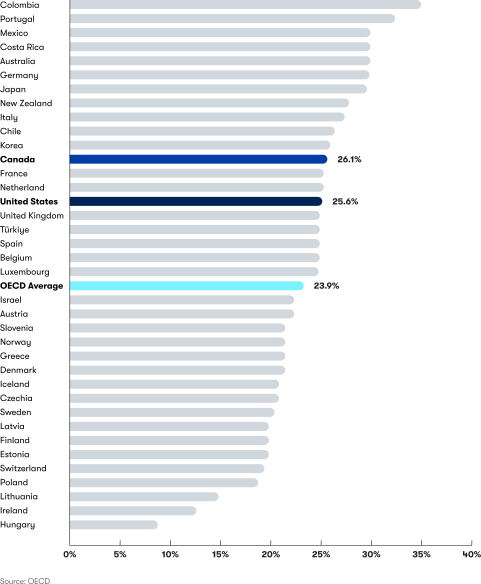
Moreover, in Canada, a large gap between general and small business CIT rates creates a perverse incentive for successful firms to avoid growth and remain below the small business deduction threshold.
CPA Ontario recommends:
- Lower the Federal and Provincial General Corporate Income Tax Rates: Cutting the combined general corporate tax rate would improve Canada’s international tax competitiveness and encourage businesses to invest.
- Mitigate Disincentives to Small Business Firm Growth: Rather than raise the small business rate, which would be politically challenging, one way to reduce disincentives for firms to scale is to raise the threshold where the general rate applies, allowing smaller firms to grow their income more before hitting the tax wall. Lowering the general corporate rate would also narrow the gap with the small business rate.
- Make Accelerated Capital Cost Allowances Permanent and Consider Full and Immediate Expensing: The federal government should fully restore accelerated capital cost allowances and make them permanent. In light of recent changes in the U.S., it should also consider moving to full and immediate expensing, allowing businesses to deduct 100% of qualifying capital investments in the year of purchase, lowering the marginal effective tax rate on investment.
“One tax change that should be done is 100% immediate deductibility for investments and make that permanent. That’s a big differentiator in terms of where to build your property.”
– John McKenzie, FCPA, FCMA, CEO, TMX Group
- Explore Distributed Profits Taxation: Going a step further, governments should consider the Estonia model of distributed profits taxation. Under this system, corporate taxes are paid only when profits are distributed to shareholders as dividends; retained earnings are not taxed. This creates a powerful incentive for businesses to reinvest earnings into growth, innovation, and productivity-enhancing capital expenditures, negating the need for initiatives like full expensing for new investments.
- Implement Group Corporate Taxation: Canada should review and consider implementing consolidated group corporate taxation, an approach used in used in some form in all other G7 countries. This allows affiliated companies to file a federal income tax return together, offsetting losses of one firm with profits of another, reducing overall tax liability and compliance paperwork.
"The lack of group tax consolidation is a substantive issue for multi-entity companies in Canada. We are harming our global competitiveness and must simplify our system."
– Andrew M. Kennedy, CPA, CA, CPA (Illinois),
Chief Financial Officer, Capstone Infrastructure Corporation
Reform Personal Income Taxes
Canada's personal income tax (PIT) system is increasingly out of step with international best practices. Canada's PIT rates are among the highest in the OECD, and top rates kick in at comparatively low income levels.
Top Combined Marginal Income Tax Rates in OECD Countries, 2024
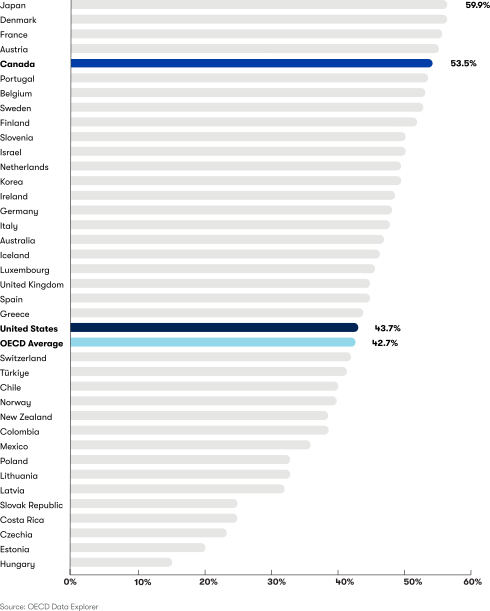
This hampers our ability to attract and retain top talent, creating a significant barrier to growth, innovation, and entrepreneurship. Ontario's surtax further adds complexity and obscures effective rates, and the lack of inflation indexation in the provincial tax system results in “bracket creep.”
CPA Ontario recommends:
- Cut Top Marginal Personal Income Tax Rates: Federal and provincial governments should work together to reduce the combined top marginal rate to ensure no province exceeds the 50% threshold, and then aim to align Canada’s rates with U.S. and OECD peers.
"Once you're giving more than half your money to the government for every additional dollar you earn, it's just a disincentive."
– Jamie Golombek, FCPA, FCA, Managing Director, Tax & Estate Planning, CIBC
- Increase Income Thresholds: The income levels at which individual tax rates apply should be raised to align more closely with international norms, mitigating disincentives to work and invest while preserving tax progressivity.
- Flatten the System: The number of tax brackets should be reduced both federally and provincially. A flatter system offers economic and administrative advantages, including lower compliance costs, minimized distortions, and increased transparency.
- Simplify Ontario’s Personal Income Tax System: Ontario should eliminate its two surtax brackets. Instead, marginal rates could be adjusted to maintain revenue neutrality while enhancing clarity and transparency.
- Index Ontario’s Personal Income Tax Income Thresholds to Inflation: Ontario should index its top two personal income tax thresholds to inflation. This approach protects taxpayers from “bracket creep,” preventing unintended annual tax increases, safeguarding households, and enhancing competitiveness.
Improve the Tax Mix
Not all taxes are created equal. Income and profit-based taxes — such as personal and corporate income taxes — impose higher economic costs than consumption taxes like the Goods and Services Tax (GST) and Harmonized Sales Tax (HST). To enhance competitiveness, Canada’s tax system needs rebalancing because our governments currently rely too heavily on the types of taxes that hurt economic growth the most. International comparisons show that Canada leans more on personal and corporate income taxes than other OECD countries, while underutilizing consumption taxes and other revenue sources with lower economic costs.
Sources of All Government Revenue in Canada and the OECD Average, 2022
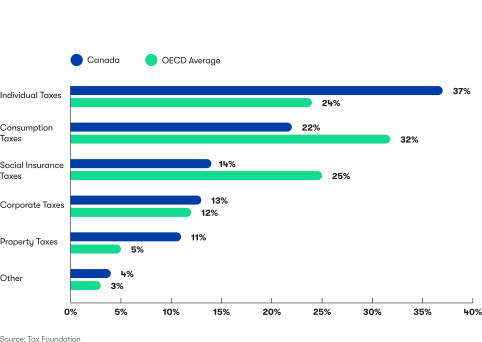
A more growth-friendly tax mix would reduce reliance on taxes that discourage productive activity and shift toward more efficient sources like consumption taxes. This transition can be designed to protect vulnerable households while improving overall economic performance.
"We're way too dependent on personal income tax and our rates are simply too high. I'd love to see us move toward the OECD average with higher consumption taxes."
– Jamie Golombek, FCPA, FCA, Managing Director, Tax & Estate Planning, CIBC
CPA Ontario recommends:
- Shift the Tax Mix to Rely Less on Harmful Taxes: Canada should gradually reduce its reliance on personal and corporate income taxes, and increase revenue from broad-based consumption taxes. This would enhance Canada's competitiveness and better align the country’s tax structure with international peers. Enhanced refundable GST credits and targeted transfers can be implemented to protect low- and middle-income households.
- Harmonize Provincial Sales Taxes in Provinces That Have Not: Canada’s fragmented provincial sales tax system adds unnecessary complexity and cost to doing business. Provinces such as British Columbia, Saskatchewan, and Manitoba should harmonize their Provincial Sales Taxes (PSTs) with the federal GST to create a HST. This would simplify the sales tax system by creating a single, value-added tax structure, reducing compliance burdens and improving economic efficiency.
Simplify the Income Tax Act
Tax reform in Canada must prioritize simplification, a view overwhelmingly supported by 84% of CPA Ontario members. Complexity leads to high compliance costs, especially for lower income households and smaller businesses, diverting resources to unproductive activity and weakening competitiveness. It also increases administration costs for government. The Income Tax Act has grown significantly, and frequent, ambiguous rule changes introduce uncertainty, eroding business confidence.
“Simplification is needed. Every new tax hasn’t just increased the tax burden, it has added extraordinary complexity.”
– John McKenzie FCPA, FCMA, CEO, TMX Group
CPA Ontario recommends:
- Review Recent Legislative Changes and Tax Expenditures: Recent legislative changes and international rules adding complexity should be reviewed to assess if they meet stated goals without undue compliance burdens. A comprehensive review of tax expenditures should also assess effectiveness and eliminate unnecessary measures.
“We should ask ourselves: are we getting bang for our buck with all these tax expenditures?”
– Dan Rogozynski, CPA, CA, CPA (Illinois), University of Waterloo
- Reinvest Fiscal Gains into Growth-Enhancing Tax Reforms: Fiscal savings from simplification — by removing ineffective tax expenditures — should be redeployed to reduce broader tax rates, specifically personal and corporate income tax rates, as these are economically harmful.
- Implement Automatic Filing for Simplicity and Equity: The federal government should implement automatic tax filing, a measure already adopted in some OECD countries. This reduces compliance costs, benefits lower-income Canadians, and increases tax filing rates, ensuring more receive valuable government benefits.
"The CRA already has all the information it needs for most low-income people. They should just file the returns automatically like other countries do."
– Kim Moody, FCPA, FCA, Founder, Moody’s Private Client
How to finance tax reform
To ensure the tax reform proposals are fiscally responsible and sustainable, the government should adopt a multi-pronged approach to financing the growth-enhancing cuts.
- Eliminate Ineffective Tax Measures. Start with a comprehensive review to eliminate inefficient and ineffective tax credits and expenditures. Canada’s tax system is cluttered with carveouts and boutique credits that add complexity without achieving their intended economic or social goals. By carefully assessing and eliminating inefficient/ineffective tax expenditures, the government can create significant fiscal room without raising headline tax rates.
- Conduct a Broader Fiscal Review. The federal and provincial governments should launch a broad fiscal review to identify program spending that isn’t delivering results in a cost-effective way or is no longer relevant — and then either reform or reduce it. They could take inspiration from the approach used by Jean Chrétien’s government in the mid-1990s, when Finance Minister Paul Martin led a review that resulted in major program reforms and a roughly 10% spending reduction over two years. This kind of effort would help create room for the tax changes being recommended. Research by economist Alberto Alesina and others shows that when governments need to tighten their budgets, focusing on spending reductions tends to be less harmful to the economy than raising taxes.
- Shift the Tax Mix. To shift the tax mix in a more growth-oriented direction, the government should modestly increase consumption taxes, such as the GST and HST, as a trade-off to reduce economically harmful income taxes. This would align Canada’s tax structure more closely with OECD best practices, which emphasize the efficiency of consumption taxes over income taxes. Given the base that the GST/HST applies to, small rate increases can yield large revenue gains. For instance, a one percentage point increase in the federal GST rate (to 6% from 5%) can yield an additional $10 billion in federal revenue, according to the Parliamentary Budget Officer’s estimates. Shifting the tax mix towards consumption could allow for bold pro-growth and pro-competitiveness changes in other areas of tax policy like personal and corporate income taxes, while producing little negative consequence for the revenues that governments need to fund critical public services.
- Expand the Tax Base Long-Term Though Dynamic Growth. Finally, it is important to recognize that the proposed tax reforms, such as lowering marginal income tax rates, reducing corporate income taxes, and introducing more investment-friendly capital gains treatment, would enhance Canada’s long-term growth potential. Over time, stronger economic growth will expand the tax base and increase government revenues, helping to offset the static cost of tax reductions. In combination, these measures can deliver a more competitive and growth-oriented tax system without undermining fiscal sustainability.
Conduct a Broad Review of Canada’s Tax System
"We can't keep tinkering around the edges with minor adjustments and boutique tax credits. Canada needs to think much bigger. Half-measures won't cut it anymore."
– Kim Moody, FCPA, FCA, Founder, Moody’s Private Client
Canada’s tax system has become increasingly complex, poorly aligned with supporting economic growth, and ill-equipped for rising competitiveness pressures. Beyond swift action on this report's recommendations, a comprehensive review is long overdue. The last major review concluded almost 60 years ago. A new Royal Commission could offer the rigorous, independent assessment needed to redesign the system for the current moment. But we don’t have the luxury of spending years on such a review; it needs to move faster than the previous Carter Commission.
CPA Ontario Recommends:
- Establish a Royal Commission:
A Royal Commission would: -
- Identify what is and is not working: Evaluate how the tax system aligns with principles of efficiency, equity, neutrality, simplicity, and competitiveness, identifying effective vs. ineffective taxes and expenditures.
- Encourage discussion and debate: A Commission-led consultation process would build consensus around trade-offs and policy options, incorporating diverse stakeholders.
- Develop bold, forward-looking options for structural change: Explore unique international approaches like Estonia’s distributed profit tax, and assess modern alternative tax models.
Conclusion
“With Trump doing what he’s doing, he’s breaking everything apart anyway. We should use the opportunity to challenge the status quo and be bold on tax. I don’t think there should be any sacred cows.”
– Dan Rogozynski, CPA, CA, CPA (Illinois), University of Waterloo
Half-measures and piecemeal reforms have left Canada with a tax system that is incoherent, burdensome, and poorly aligned with the country's economic goals. While targeted changes are necessary to address immediate competitiveness concerns, a comprehensive structural reset is now essential. A new Royal Commission, informed by expert guidance and international best practices, would provide the blueprint Canada needs to build a tax system for the 21st century.
Tax reform faces real political obstacles, but the political difficulty cannot justify continued inaction when Canada's economic competitiveness hangs in the balance. From simplifying the Income Tax Act and improving the tax environment for talent to reforming innovation incentives and modernizing capital gains policy, the recommendations in this report represent a pro-growth, pro-productivity tax reform agenda for Canada. While tax policy is a key lever, it’s not the only one. Other changes, such as cutting red tape, improving fiscal discipline, strengthening innovation policy, and investing in productivity-enhancing infrastructure, are also essential to move Canada forward. In the face of rising global competition and a weakening domestic economic foundation, it is time for policymakers to act with urgency and ambition — even when politically challenging. Canada's future prosperity depends on it.
Disclaimer:
While this Report in Brief uses the shorthand term “CPA Ontario recommends,” these recommendations are informed by a December 2024 survey of CPA Ontario members on tax policy, consultation with leading experts in tax policy, and extensive academic and policy research. The recommendations may not necessarily reflect the views of all CPA Ontario members, CPA Ontario Council members, CPA Ontario employees, the individuals who were consulted, or their affiliated organizations.
Acknowledgements
CPA Ontario engaged several leading tax policy experts to inform these recommendations. We extend our sincere thanks to everyone who generously shared their time and insights in the preparation of this report, including:
Albert Anelli, FCPA, FCA
Managing Partner, Tax, EY Canada
Brian Ernewein
Senior Advisor, National Tax Centre, KPMG in Canada
Jamie Golombek, FCPA, FCA
Managing Director, Tax & Estate Planning, CIBC
Rob Jeffery, CPA, CA
Partner, Tax, Deloitte Canada
Andrew M. Kennedy, CPA, CA, CPA (Illinois)
Chief Financial Officer, Capstone Infrastructure Corporation, and CPA Ontario Council member
John McKenzie, FCPA, FCMA
CEO, TMX Group
Kim Moody, FCPA, FCA
Founder, Moody’s Private Client
Colin Mowatt, CPA, CA
Canadian Tax Policy Leader, PwC
Fred O’Riordan
National Leader, Tax Policy, EY
Matthew Roman, CPA
Partner, Tax, KPMG in Canada, Chair of the CPA Income Tax Education Committee, CPA Board of Examiners Member
Dan Rogozynski, CPA, CA, CPA (Illinois)
University of Waterloo, and CPA Ontario Council member
John Ruffolo, FCPA, FCA
Founder and Managing Partner, Maverix Private Equity
John Waters, CPA, CA
Vice President, Tax Consulting Services
RBC Wealth Management